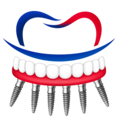
What All-on-6 Actually Means
All on 6 (also written All-on-6 or allon6) is a full-arch dental implant treatment in which one complete arch of fixed teeth is supported on six titanium implants. The six implants are placed into the jawbone and a permanent bridge of replacement teeth is screwed onto them, giving you a fixed set of teeth that cannot be removed at home. It is the go-to solution for patients missing all or most of their teeth in a jaw, and in Turkey an All-on-6 arch costs from £4,100 per arch (full package from £8,650) versus £15,000–£25,000 in the UK. Our recommended All-on-6 clinic for UK patients is Taki Dent in Antalya, led by Specialist Prosthodontist Dr. Sadık Taki.
All-on-6 is a full-arch dental implant treatment. The name refers to the fact that an entire arch of fixed teeth — upper or lower — is supported on six titanium implants. Those six implants are placed directly into the jawbone during a surgical procedure, and a complete prosthesis (a row of artificial teeth attached to a gum-coloured base) is then secured onto them.
The titanium implants fuse with the surrounding bone through a biological process called osseointegration. Over a period of roughly three to six months, the bone grows around the implant surface and locks it firmly in place. This is what makes the final result feel and function like natural teeth — the prosthesis has a solid anchor in the jaw rather than sitting on top of the gum.
Once fully integrated and fitted with a permanent prosthesis, the result is a fixed set of teeth that cannot be taken out. Patients clean around them with specialist brushes and water flossers, but there is no nightly removal, no adhesive, and no movement when eating.
How It Differs From Dentures
The key distinction between All-on-6 and conventional full dentures is fixation. Dentures sit on top of the gum and are held in place either by suction (particularly for upper dentures), denture adhesive, or clips onto remaining teeth. They move during eating and speaking to varying degrees, and many patients find them uncomfortable over time as the gum ridge changes shape.
All-on-6 eliminates all of this. The prosthesis is bolted onto the implants, and it does not move. Patients can eat most foods, speak without concern about movement, and do not need adhesive. The experience is much closer to having natural teeth than any removable option can provide.
There is also a clinical difference in how the two options interact with the jawbone. When teeth are lost, the bone that supported them begins to shrink — a process called resorption. Dentures do nothing to prevent this; in fact, the pressure from a denture can accelerate it. Implants, by contrast, transmit chewing forces into the bone in a way that stimulates it and reduces resorption. Over the long term, this means the face shape is better preserved with implants than with dentures.
How It Differs From Individual Implants
If a patient needs multiple missing teeth replaced, they have two broad options: individual implants (one implant per missing tooth) or a full-arch solution like All-on-6. The choice depends on clinical factors, cost, and the scale of the problem.
For patients missing just one or two teeth, individual implants are the standard approach. For patients missing the majority of their teeth — or whose remaining teeth are failing and need to come out — All-on-6 is often more practical. It requires six implants regardless of how many teeth are being replaced, making it significantly more cost-effective than placing 12 or 14 individual implants to replace a full arch.
The treatment timeline also differs. With individual implants, each implant can be treated somewhat independently. With All-on-6, the whole arch is planned and delivered as a single coordinated treatment, which can actually be more efficient for patients who need extensive work.
Single Arch vs Full Mouth Rehabilitation
All-on-6 can be placed on the upper jaw (maxilla), the lower jaw (mandible), or both. Treating both arches is sometimes called a full-mouth rehabilitation. The decision depends entirely on the patient's situation: which teeth are missing, whether any healthy natural teeth remain, and what the opposing bite looks like.
Many patients come in needing just one arch treated because their natural teeth on the other side are still in reasonable condition. Others require both arches, particularly if years of neglect or systemic conditions have affected all their teeth. A proper clinical assessment — including a CT scan and bite analysis — determines which approach is appropriate.
Full-mouth rehabilitation costs roughly double a single arch, but the surgical procedure is often done in one session, saving travel time for patients seeking treatment abroad. You can read more about the cost picture in our All-on-6 cost guide.
What the Prosthesis Is Made Of
The teeth you see — the prosthesis attached to the implants — can be made from different materials. During the healing phase, a temporary prosthesis is almost always acrylic (a type of medical-grade plastic). This is lighter, easier to adjust, and less expensive to produce. It serves as the functional temporary while the implants integrate.
For the permanent prosthesis, there are two main options. Acrylic (PMMA) remains an option for the permanent phase as well — it costs less and is lighter, but tends to wear and stain more over time. Zirconia is the premium alternative: it is extremely hard, highly aesthetic, and very resistant to staining. The downside is that it costs significantly more and is more complex for the lab to produce. It is also harder to adjust once fitted.
Which material is right for a patient depends on budget, aesthetic expectations, and clinical factors. Some patients are happy with a well-made acrylic prosthesis; others specifically want zirconia for the aesthetics and longevity. Always confirm in writing which material your permanent prosthesis will be made from — it should be specified in your treatment plan.
What All-on-6 Cannot Do
All-on-6 is not suitable for everyone. The six implants require sufficient bone volume in the jaw to anchor them safely. Patients who have significant bone loss — often those who have worn dentures for many years — may not be immediately suitable. In some cases, bone grafting can build up the jaw to make implant placement possible, but this adds time and cost to the process.
Certain medical conditions also affect candidacy. Uncontrolled diabetes, active cancer treatment, patients on certain bone-affecting medications, and heavy smokers all face higher risks of implant failure. These factors do not automatically rule a patient out, but they require careful evaluation before treatment proceeds.
All-on-6 is also not a substitute for addressing the underlying reasons teeth were lost. Patients need to be committed to the maintenance routine — specialist cleaning tools, regular hygiene appointments, and annual implant checks — to protect their investment long term.
For a full picture of whether you might be a candidate, read our guide on All-on-6 assessment and candidacy.
Further reading from Dr. Sadık Taki
Long-term success with All-on-6 depends on how the jawbone behaves around the implants and on diligent upkeep of the prosthesis. Specialist Prosthodontist Dr. Sadık Taki — who leads our recommended clinic, Taki Dent in Antalya — explains both in plain English, drawing on his own peer-reviewed research:
- What Really Drives Bone Loss Around Dental Implants — a lay summary of his three-year study on marginal bone loss around implants.
- Implant-Supported Dentures: Why the Upkeep Matters — why maintenance is as decisive as the implants themselves for full-arch longevity.